INTERVIEW: Director Jay Silverman on YALE Premiere and Filming in Los Angeles
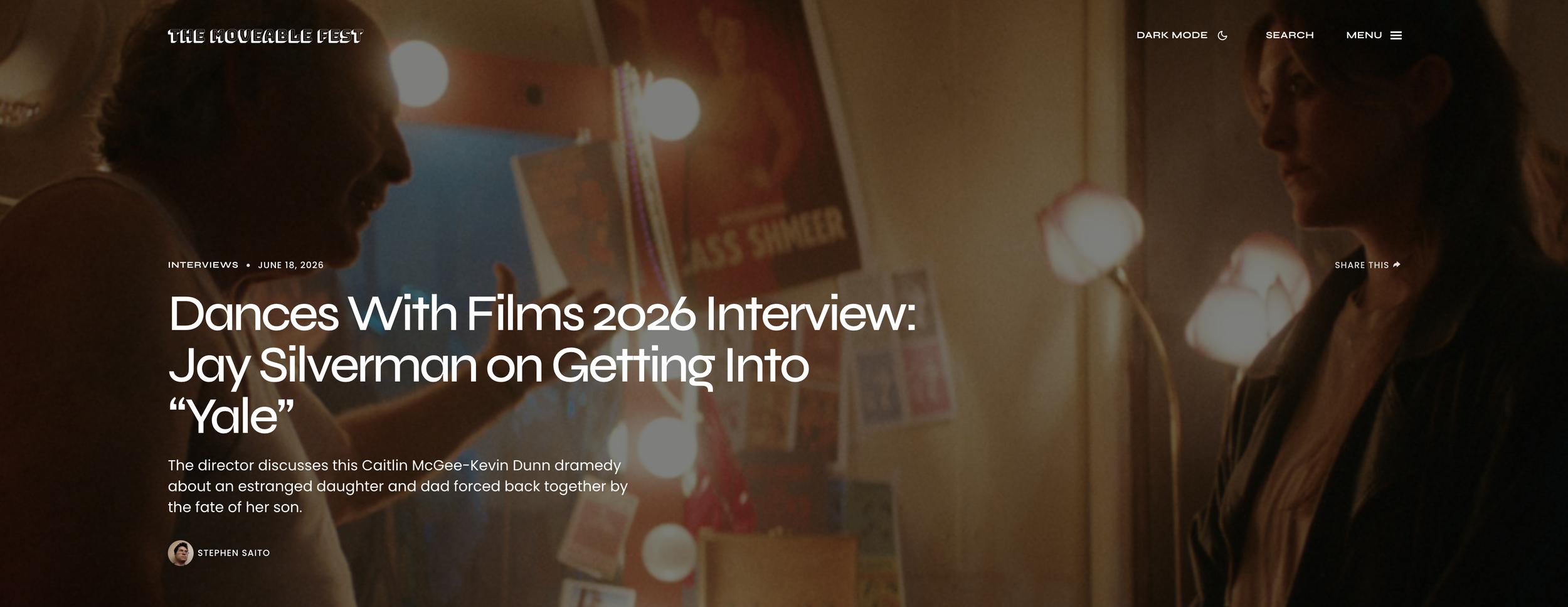
Yale Parker (Kevin Dunn) announces he has a 75-mile rule to his estranged daughter Mack (Caitlin McGee) in “Yale,” noting that all bets are off after he reaches that distance away from home as the two hit the road. She’s well-aware of the rule even if she’s never heard it articulated in such a way before when she never saw Yale again after her ninth birthday, told by her mother that he called from a cruise ship he was working as an entertainer and had no plans to return home. She ended up writing horror novels, though nothing autobiographical from the traumatic experience, which may have played a part in often drinking a little too much, and she would have no desire to ever see him again except for the fact that she’s suddenly on the lookout for DNA matches with her 12-year-old son Ryan, who is diagnosed with a kidney disease that is complicated by having an extremely rare blood type.
Based on the true story of screenwriter Van Billet’s grandfather, who was known to cat around, “Yale” charts an uncomfortable family reunion when by the grace of God Mack is able to track her father down, but it only leads to plenty more questions upon finding him emceeing at a burlesque show straight out of the 1960s where much of his sensibilities remain. Director Jay Silverman oversees a brutal clash of personalities at first in the dramedy where Mack isn’t only disheartened by her son’s dire prognosis or having to turn to her erstwhile father for help, but appearing in a funk as far as her own professional ambitions go, turning to the bottle more and more for comfort, yet just as she starts to discover all the craziness around her can be grist for the mill, the film itself turns an outrageous situation into something heartfelt as the daughter may never quite connect with her father, but the time spent with him strengthens family ties beyond what he may be able to do for her own son.
“Yale” will make its world premiere tonight at the Dancing with Films Festival in Los Angeles, which has a special meaning for Silverman aside from the fact the film will screen at the TCL Chinese where he has personal memories. The film was a rare recent film to stay in the city, despite its Philadelphia setting, and the director recently took the time to talk about the importance of keeping production local and making the most of a modest budget, as well as making a film based off of a real-life incident and achieving just the right tone.
How did this come about?
It was a five-year journey. My producer Bethany Cerrona found the screenplay on the Black List and we had coincidentally already worked with the writer Van Billet on a movie called “Saving Paradise,” and this is a story about his grandfather. Since we worked with him on “Saving Paradise,” we became really quite acquainted with one another and to have the luxury of collaborating with the writer on his own material was a big deal because there are no filmmakers that are going to listen to this that doesn’t want to change a word in the screenplay, not necessarily because they don’t like it, but because they need to make his day or there’s too many scenes in the movie. So we spent five years developing this into a story that was both exciting but at the same time complex.
Not to shortchange the dramatic elements of this, but “Saving Paradise” was a lot more serious. Was it fun to do something more on the comedy side?
It’s pretty darn exciting. Working with Kevin [Dunn] and putting words in his mouth was a cathartic experience because any filmmaker that’s trying to do dramedy, which is really what we’ve done here, it’s a real fine line. What you don’t want is people to become caricatures, and you also don’t want is to lose the drama and it’s interesting to discover that the jokes which are coming from the character’s actions are for the benefit of the storytelling, but I don’t think the characters themselves are enjoying the funniness, which is the best part.
What drew you to working with Kevin on this?
Interestingly enough, we were lucky enough to have a relationship with Gersh and they provided many of the stars in the movie. That gave us a lot of confidence because they liked the screenplay and they wanted to inhabit the characters with their people, and one of the reasons we shot in L.A. is because the quality of the talent that’s available in Los Angeles would be totally unaffordable if we were to shoot all of them in Georgia, for example, to take advantage of the incentive because some are only working two, three days and they’re not going to want to do the job. But the fact that they can sleep in their own bed and be in the movie was an enticement.
You’re able to make L.A. stand in for Philadelphia. What was it like to pull off?
That’s the fun part of making movies is we have many people that have told us that for sure we shot the movie in Philly. The writer’s from Philadelphia, and just like in my previous movies I visited Philadelphia multiple times and then I went back with Andrew Jeric, the [director of photography], to do the B-roll. One of the interesting parts about making an independent movie, especially in 2026, is technologically you have the advantage of things that just simply didn’t exist five years ago and the fact that we could buy eight angles of a car POV, seeing the front windshield, seeing out the back windshield, seeing out the side windshield is something that we took advantage of [to have the view of Philadelphia]. And since it’s a road trip movie, you could just imagine how in the heck are you gonna make this movie in 18 days if you If you’re shooting all on a location, you just can’t do it.
You find one really interesting rooftop location. What was that like to have as a setting?
That was exciting because when you’re developing a movie, the writer might describe her living conditions to be “mildly challenging,” but it’s the director’s job to extrapolate that with the production designer and we had the fortune of Stephanie Reese, who was the production designer, really pulling out all the stops and collaborating with the DP and myself to make a location in L.A. believable as being somewhere out of state, but more importantly having the textures and the beauty. All you’ve got to do is go to Philly and compare it to downtown LA and there’s a lot of similarity.
What was it like working with your cinematographer? The camera can really emphasize the humor with the sharp whip-pans and it appears that you’re working a lot with handheld, which is an unusual choice for a film like this?
Andrew Jeric worked with me on my last movie called “Camera” with Beau Bridges, and that was an [explicitly] photographic story, and it just seemed to be the same language I wanted to do with this movie. It’s very kinetic and this movie is all shot handheld. And Andrew is a steady guy. You don’t have to tap them on the shoulder and [say] “Go get the hands,” or “Come over to the side.” I always dreamt to make my movies where the camera’s always moving and the way things go nowadays, when you’re trying to shoot a scene that maybe is a half-a-page or dialogue that’s comedic and at the same time incredibly dramatic, it’s probably the best solution because it it’s not all cutty. It’s organic, and if the actors can do their job, which they blew us away with, you’re able to shoot multiple takes and intercut them.
That diner scene is really interesting in that regard – it may not sound like much to describe, but as the two leads are sitting in a booth, you’ve got shots of them from the kitchen and behind the counter, among plenty of other angles. What was it like to figure that out?
The whole movie was extraordinary from a production standpoint because let’s be honest, some stuff is best as a oner, and that isn’t to be economic, but that is just a statement. It’s an emotional scene. There’s no reason for you to go cut, cut, cut. The diner was a more traditional set. Number one, it wasn’t even a real diner. It’s a location here in Los Angeles. Number two [the various angles] provided a lot of texture and the characters are so dynamic in respect to their inability to have any kind of boundaries and I thought it was super important to play all the people that were in the diner with the environment, even though some angles you see for one- and-a-half seconds.
What was it like when you actually got Kevin and Caitlin together and see what their dynamic might be like?
All your viewers who are interested in indie movies all probably feel the same way I do. What’s the formula? All the interviews you can watch of Christopher Nolan or Spielberg or Scorsese, working for three months with the talent and cooking pasta for them and so on and so forth —we didn’t have the liberty of that. Our actors showed up one day before the shoot and we were able to bring them into my studio and do a read-through and it began right there. But so much of the obstacles that you see in filmmaking are created by the filmmaker and there was instant awareness by myself and the writer that these [actors] understood whom they were playing and engaged because if you have a writer that’s sitting with you as a filmmaker — a luxury in my view, you have an ability to go, “Hey. Did you mind that they dropped [that one line]?” I’m working on another movie right now, and I’m always trying to go, “Is there another way to say this without words? And that to me is the luxury of having rehearsal time because I don’t need to tell you that that character is living with the death of somebody in his family. I want to see it, and I want the other character to look at him and go, “You got something going on there.”
It must be surreal if Van was on set, beyond having him around for expertise, having this bit of family history unfold before his eyes.
That’s an interesting thing because I lived that same experience in my first movie, “Girl on the Edge.” I’m sitting in the very room [now] that one of the most dramatic scenes takes place and I’ve got two people, one playing me and Peter Coyote playing a therapist and in this case, it was startling to see this idea brought to life because it’s about real people. And I know this sounds crazy, but in a previous interview I described the two characters [in “Yale”] as being terrorists — I’m being sarcastic, but they have no boundaries and at the same time, they are lovable. People ask me, how did you pull that off? I’m not even sure how I did, because it would be the scariest thing for me. When I was younger, I remember a major executive at one of the studios telling me after he read one of the scripts I was developing, the character’s not likable and [being told] “You need to develop him more because nobody likes an unlikable character. But I make an analogy about Tony Soprano,. He’s so unlikable as a human being, but he’s got character at such a level that makes you want to love them. That’s what I tried to serve here with Kevin and Caitlin’s performances.
Was there anything that changed your ideas about this as you were moving through or took it in a direction you might not have expected but could get excited about?
We made the movie in 18 days. Anybody that’s made an indie movie knows that you’ve got to have pre-production down at a high level, so you can go, “Oh, let’s let the talent explore.” I do believe that in a positive way after the fact, the actors know in so many situations way better than the director about storytelling and it is exciting to see the interpretive come from the actors. And I’m not telling you they’re telling me what to do, but sometimes, they wake up in the morning and say, “Have you thought about this, Jay?” And it wasn’t pleasant at the time, but I listened to them. And sometimes it was not only effective, it was phenomenal.
And you’re only as good as the team that you work with when you’re making a movie, whether it’s a big movie or an indie. We had the most incredible casting agent, Beth Holmes and Stefano [Tomaselli], a composer from Italy who just knocked it out of the park, and Brenda [Dyk] did the costumes phenomenally. I just wanted to mention that because your fulfillment comes in knowing that that collaboration worked.
I did have to ask about the music because I noticed it was all done in Italy, and has the right flavor for a film like this despite taking place in the States. How did the score come about?
it’s an interesting question because [Stefano] came into my studio unannounced and introduced himself and he is quite charismatic. The outcome of it is that we did know that we wanted a kind of a tilt of the hat to Kevin as his generation would likely be that kind of [gregarious] music. And I do believe in what Spielberg said that John Williams is in his opinion 50% of why “Jaws” was successful and I do believe Stefano did the same thing with my movie, and so did Andrew with the [camera] and so did John Thompson with the editing. You start to put the puzzle together and you start to see that being open to surprises is very fulfilling.
What’s it like getting to this point with it to premiere it at Dances with Films?
It didn’t even occur to me [until recently] that when I was in my early teens I saw “Star Wars” at this exact theater on Hollywood Boulevard [where “Yale” will premiere], so this is a dream come true. It’s also an incredible privilege to be chosen as the opening film of a festival because they’re condoning the fact that it’s entertaining and we in the independent world, the fulfillment of that is beyond words because we’re all here to try to grow and be a part of something bigger. That’s what I love so much about what I do.